Friday, May 30, 2008

Heart Health is a Laughing Matter

It turns out, whoever said "laughter is the best medicine" wasn't too far off the mark - at least where the heart is concerned. A recent study revealed that laughing has surprisingly beneficial effects on your heart.
Researchers at the University of Maryland Medical Center in Baltimore studied 20 healthy, young adults who watched 15 to 30 minute segments of either funny or sad movies. After watching humorous clips, the researchers observed increased blood flow in 19 of the participants that was comparable to performing aerobic exercise or beginning a cholesterol-lowering statin treatment. The researchers also found that watching a good tearjerker had the opposite effect, actually lowering 14 of the participants' brachial blood flow an amount equivalent to remembering periods of anger or doing mental arithmetic.
Before the study commenced, the participants were tested and were all found to have normal blood pressure, cholesterol and blood glucose levels. They were also asked to fast overnight and refrain from aerobic exercise or consuming alcohol, vitamins or herbs the evening before the viewings, since these can all affect blood flow.
Prior to seeing a movie, the volunteers were tested for their blood vessel reactivity in order to measure what is known as flow-mediated vasodilation. During the test, blood flow in the brachial artery in the arm was restricted by a blood pressure cuff and then suddenly released. An ultrasound device was then used to measure how well the blood vessel responded to the abrupt increase in flow. The brachial artery runs from the shoulder to the elbow and is a good indicator of blood flow throughout the body. Researchers collected a total of 160 measurements of brachial artery flow from the participants a minute before and after phases of laughter or sadness.
Volunteers watched each segment of the movies while lying down in a temperature-controlled room, after which the brachial artery was tested for blood vessel reactivity. Each volunteer was shown part of two movies at the extreme ends of the emotional spectrum, randomized to first watch either a movie that would cause mental stress, such as the opening scene of "Saving Private Ryan," or a segment of a movie that would cause laughter, such as "King Pin." At least 48 hours later, they were shown a movie intended to produce the opposite emotional extreme. Overall, average blood flow increased 22 percent during laughter, and decreased 35 percent during mental stress.
"I think it would be reasonable for everybody to loosen up, and spend about 15 to 20 minutes a day laughing," said lead researcher Dr. Michael Miller, director of preventive cardiology at the University of Maryland. "The magnitude of change we saw in the endothelium is similar to the benefit we might see with aerobic activity, but without the aches, pains and muscle tension associated with exercise," says Dr. Miller. "We don't recommend that you laugh and not exercise, but we do recommend that you try to laugh on a regular basis."
Learn more: http://www.parentingweekly.com/pregnancy/breathingspace/vol03/heart_health.asp

Friday, May 23, 2008

Nettles for pregnancy nutrition boost


Stinging Nettle (Urtica dioica)
Drinking nettle infusion before and throughout pregnancy can gently loosen, dissolve, and eliminate any accumulated minerals in the kidneys, such as gravel or stones, as well as nourish and strengthen the kidneys. This is especially important during pregnancy because your kidneys must cleanse 150 percent of your normal blood supply.
Nettles are also known for reducing hemorrhoids, tightening and strengthening blood vessels, helping maintain arterial elasticity and improving venous resilience, and have historically been used to combat pregnancy-related anemia. They also increase fertility in women and men, diminish pain during and after birth, and increase the richness and quantity of breast milk. Their highly-absorbable calcium content also helps diminish muscle pain in the uterus and legs.
The high vitamin K content of nettles helps to elevate the amount of available hemoglobin in the blood, which can decrease the likelihood of postpartum bleeding. Some pregnant women alternate drinking nettle and raspberry brews; while others drink raspberry until the last month of their pregnancy and then switch to nettles to boost their vitamin K levels before birth.
Nettle leaves contain as much carotene and vitamin C as spinach, are thought to have more chlorophyll than any other herb, and provide significant amounts of vitamins A, D and K, calcium, potassium, phosphorous, iron and sulfur. When brewed as an infusion, it is a dark green color approaching black with a rich, deep taste.
Fresh nettles may be boiled or steamed (handle uncooked fresh nettle leaves with gloves to avoid being pricked) and served as a side dish, or dried leaves may be brewed into tea. Nettle juice and freeze-dried powdered nettles in capsules are also available at health food stores.

Friday, May 16, 2008

Happiness Breeds Success

What makes some people more successful than others? A better education? A stronger desire to get ahead? According to new research, these people may be more successful simply because they are happy.
Scientists recently reviewed 225 studies involving 275,000 people and found that chronically happy people are, in general, more successful in their personal and professional lives. "Perhaps happy people ... have a lot of good things come to them because of their happiness, their sociability, their energy," said lead author Sonja Lyubomirsky, a professor of psychology at the University of California, Riverside. Reporting in the January issue of Psychological Bulletin, Lyubomirsky pointed out that throughout most of its history, psychology has tended to focus on what goes wrong with people emotionally; only recently has it switched that focus to the exploration of "good" emotions like happiness, contentment and joy. "It's a trend called 'positive psychology'," she explained.
At first, most of this work on happiness focused on its origins, Lyubomirsky said. "So, if you had a study and you saw a correlation between rising income and happiness, it was immediately interpreted as 'OK, money makes people happy'." However, the old saying that "money can't buy happiness" may be correct, too. The study surveyed people on the Forbes 200 list and found them only marginally happier than the ‘average Joe’. In fact, many of them cited feelings of accomplishment in their business and family as being bigger factors in their happiness than the money they had made.
"It's clear that the relationship is bi-directional," Lyubomirsky said. "It's an upward spiral." Hundreds of other studies appear to support that theory. In an infant study, babies who smiled and laughed more developed stronger bonds with their caregivers. Numerous studies have shown that happier people tend to perform better in job interviews, secure better jobs, and get more positive job-performance ratings while working. Other research has shown that happier individuals had more satisfying marriages and were more likely to describe their partner as their "great love." Happy people were also more likely to engage in new, pleasurable pursuits and recognize rewards in the most ordinary, mundane events. And experimental studies suggest a good mood can boost immune function, reduce colds, and even lengthen lifespan.
One of Lyubomirsky's recent studies focused on 30-year-old college yearbook photos. Researchers assessed each photo for what experts call "Duchenne smiles," a certain play of facial muscles that only occurs during truly happy, un-posed smiles. "Only very, very good actors can fake them," Lyubomirsky said. "In these yearbook studies, women who showed Duchenne smiles when they were in college had happier marriages by age 52," she said. In fact, studies consistently find that when people appear happy, total strangers rate them as sexier, too. "They're also more sociable, and sociability is really important," she says. "You get out there, you like people more. And people are more motivated to work with, and be friends with, happy people."
Learn more: http://www.parentingweekly.com/pregnancy/breathingspace/vol01/happiness_breeds_success.asp

Friday, May 9, 2008

The Spiritual Center


Sit in a comfortable sitting position, preferably cross legged.
Center your attention on the point located two inches below your navel, the spiritual center of the body.
Begin rocking back and forth slowly, decreasing the arc with each rock until you rest at your natural center of gravity.
Press your tongue on the upper palate. Breathe through your nose and taste your breath. Imagine your breath coming down into the spiritual center below your navel and returning.
Begin counting each inhalation and exhalation. Count to ten and then go back from ten to one, starting over once you reach one. If any thoughts arise, acknowledge it and let it pass by returning to the count.
Each time you redirect your thoughts, you are giving yourself the power to put your mind where you want it.

Friday, May 2, 2008

Is Maternal Instinct Really Instinct?

Are you one of those women who never felt like she had the "maternal instinct"? Are you still nervous that you won't know what to do when your baby cries? Are you still waiting for it to magically kick in now that you're pregnant? Many women experience such anxiety, but researchers are now studying whether maternal instinct may in fact be something we learn and not something we're born with.
One scientist who believes that mothering behavior is learned and not instinctual is Sarah Blaffer Hrdy, professor emeritus of anthropology at the University of California at Davis and author of Mother Nature: A History of Mothers, Infants, and Natural Selection. Hrdy has studied primates for more than three decades and believes that the desire of a mother to care for a child depends on her desire to be a mother and the amount of time spent bonding together. Although she concedes that maternal responses exist, she believes they are biologically conditioned, but not true instincts. In an interview with Salon.com she said, "A woman who is committed to being a mother will learn to love any baby, whether it's her own or not; a woman not committed to or prepared for being a mother may well not be prepared to love any baby, not even her own."
Hrdy argues that human babies are genetically engineered to convince their parents that they are worth raising, citing the plumpness of human babies (not seen in other primates) and their irresistible smile as examples. And given the right circumstances, even fathers can display maternal behavior, as seen in 1986 when a small boy fell into the gorilla enclosure at the Jersey Zoo in the United Kingdom and was - surprisingly - protected by an otherwise aggressive male silverback gorilla.
According to Hrdy, natural selection is the primary reason that males do not typically display maternal behavior. The paternity of a child can always be questioned, and if a male were to spend his time tending to offspring that were not his own, he could be limiting his own gene pool. But because maternity is never in doubt, females are more naturally inclined to tend to babies.
Hrdy acknowledges that in order to survive, babies must become attached to a caregiver, but she contends that the individual need not be the infant's biological mother. It is simply because of birth and lactation that the baby will probably form its closest relationship with its mother and she in turn will be motivated to care for the baby.
According to Craig Kinsley, PhD, "The mammalian female brain expresses a great deal of plasticity and creativity in service to, and in support of, reproduction. In other words, mothers are made, not born."
Kinsley and his colleagues in the departments of psychology at the University of Richmond and Randolph Macon College have shown that upon becoming a mother, a female rat's learning, memory, time management and efficiency improve. The brains of these rats actually change to enhance spatial ability and reduce fear and anxiety to help the new mothers care for and protect her offspring. In addition, the new rat mothers developed better hunting skills, taking just 70 seconds to track, attack and kill a cricket, compared to the 290 seconds it took childless rats.
Scientists on the other side of the maternal instinct debate have begun monitoring brain waves of new parents and have discovered maternal brain activity that points to genetic hardwiring. Researchers at Medical University of South Carolina found that mothers had a more widespread reaction to their infant's cries than in response to an unrelated infant's cries, and a greater response than the baby's father. While fathers showed increased activity only in parts of the brain thought to be more involved in thinking, distinguishing between sensations, and motor planning (posterior neocortical and cerebellar regions), mothers showed an increase in those areas as well as the limbic and basal forebrain regions, which are important in emotional responses.
According to Jeffrey Lorberbaum, MD who led the study, "Mothers may be very attuned to their own infant as they activate widespread brain regions including ancient regions believed to be important in rodent maternal behavior. Fathering behavior may be less hardwired and a more recent evolutionary phenomenon as fathers only activate newer regions of the brain involved in sensory discrimination, cognition, and motor planning in response to cries."
However, Hrdy maintains that "maternal responses that are biologically based are surely going on in the human species." But she believes that the bonding that takes place between mother and child occurs due to the flood of chemicals and hormones that occurs during pregnancy and after birth, and deepens the longer the baby is close. But this is not the definition of an instinct and although we may be vulnerable to maternal impulses, we are not "controlled or defined by them."
Learn more: http://www.parentingweekly.com/pregnancy/breathingspace/vol39/pregnancy_health_fitness.asp

Friday, April 18, 2008

Nature's Collective Intelligence


Ever wonder how anything gets accomplished within the apparent chaos of ant colonies and bee hives or how schools of fish and flocks of birds suddenly shift direction with such precision? These animals rely on collective thought, which scientists have dubbed swarm intelligence. This type of group thinking not only brings order to millions of creatures living closely together, it may have broader applications in our own world to increase efficiency, safety, and the way we live.
Ant colonies can range in size from hundreds to even millions of occupants, yet despite such density, they maintain highly organized communities and every ant knows his duty. This phenomenal management that enables the ants to allocate tasks, defend territory and find the optimal path for food is due, ironically, to a complete lack of centralized leadership and the ants' ability to communicate information and trust individual input. There is no single leader of an ant colony - the queen is just there to lay eggs - instead, the entire colony relies on the interactions between individual ants, each of which is following simple rules of thumb, a system scientists call self-organizing.
Ants communicate mostly through touch and smell, so when they bump into each other they sniff antennae to confirm the other's identity, role in the colony, and other important information. For example, the return of patroller ants that are sent out of the colony each morning serves as a signal to the forager ants that it's time to go out. But the foragers also glean information about outside conditions, potential predators, and food availability based on how many and how frequently they run into patroller ants and other returning forager ants. According to Deborah Gordon, a biologist at Stanford University studying red harvester ants in the Arizona desert, "A forager won't come back until it finds something. The less food there is, the longer it takes the forager to find it and get back. The more food there is, the faster it comes back. So nobody's deciding whether it's a good day to forage. The collective is, but no particular ant is."
Honey bees also use individual input to make hive-wide decisions, such as where to construct a new hive when the current one grows too large. The bees scatter to search for the best real estate. When they return to the queen, they do a little dance called a waggle to show their enthusiasm for the new hive site they found. Other bees investigate based on the dance and congregate and dance near the best new home. The location with the most dancing bees becomes their new abode. The bees' ability to investigate and consider multiple options and then decide on a course of action based on popular vote leads them to the best choice.
Thomas Seeley, a biologist at Cornell University, has studied bees for more than 10 years and believes that their decision making could be applied to corporate meetings where decisions could be made by bringing all possibilities to the table, discussing the ideas and then voting by secret ballot.
The collective decision making process of swarms has also inspired some in the corporate world to integrate these methods to improve the way they do business. One such company, called American Air Liquide, which produces medical and industrial gases such as hydrogen, oxygen and nitrogen, developed a computer program that mimics an ant found in Argentina that uses a pheromone trail to communicate to other ants in the colony the quickest path to the best food source. The scent of the trial is reinforced each time an ant travels that path, further reinforcing the behavior. American Air Liquide uses virtual "ants" to mark the shortest and most reliable routes for their delivery trucks. Their artificial colony approach also uses genetic algorithms based on factory schedules, weather, estimated customer demand and costs to find the most efficient business model each day. Dairy, heating oil, grocery and telephone companies across Europe are also finding this artificial pheromone trail system useful in their industries.

Friday, April 11, 2008

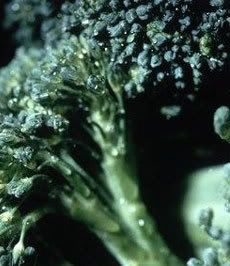
Broccoli: The Nutritious Warrior


Many nutritionists have dubbed broccoli a "SuperFood" - and with good reason. This tasty, versatile and nutrient-packed member of the cabbage family packs a strong anti-oxidant punch that can help fight many types of cancer, while also providing a hefty dose of calcium for strong bones and folic acid to prevent birth defects.
Broccoli contains the phytonutrients sulforaphane and indoles, which have been shown to effectively fight many types of cancer. Indole-3-carbinol has been found to deactivate an estrogen metabolite that promotes tumor cell growth, while increasing levels of a cancer protective form of estrogen called 2-hydroxyestrone. It also inhibits the movement of cancerous cells through the body.
Sulforaphane boosts detoxification enzymes to clear potentially carcinogenic substances from the body more quickly, while halting cell growth and increasing the self-destruct mechanism in abnormal cells. New research has shown that this phytonutrient can help repair sun damaged skin as well.
When broccoli is cut, chewed or digested, it releases glucose along with compounds that help to break down food, including isothiocyanates, which stimulate enzymes in the liver that detoxify carcinogens. One form of isothiocyanates, known as allyl isothicyanate, inhibits cell division while encouraging the self-destruct function in abnormal cells. These characteristics make regular consumption of broccoli a tasty way to reduce your risk of many types of cancer, including breast, prostate, colorectal and lung.
Broccoli is especially good to consume during pregnancy. It is packed with nutrients and an excellent source of calcium (74 mg per cup), vitamins C (124 mg per cup) K, and A, folate (94 mcg per cup) and fiber. The high calcium content helps to build and maintain healthy bones for your baby and you, while the folic acid helps prevent spina bifida and other birth defects, and the fiber content helps relieve constipation. Broccoli's high beta-carotene content helps fortify your immune system and promotes clear skin. Broccoli is also a good source of phosphorus, magnesium, potassium, and vitamins E and B6.
It is estimated that about 50 percent of Americans are infected with a bacterium known as H. pylori, which can cause ulcers and damage DNA. Eating broccoli sprouts has been found to suppress this potentially deadly bacterium and relieve the gastritis associated with it. Broccoli sprouts also provide 10-100 times the sulfur-containing phytonutrients as mature broccoli to detoxify carcinogens and boost enzymes.